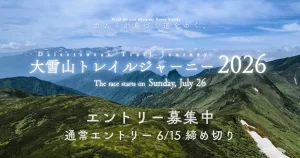
Event report
On Sunday, July 20, 2025, the 2025 Daisetsuzan Trail Journey was held and concluded successfully.
The weather had been unstable since July 19. We set up the venue in light rain. Although the rain never became extremely heavy, it never stopped. Due to the high risk of traveling on the Hirayama Ridge and the potential damage that a large number of participants could cause to the mountain trail, we announced a course change on July 19 at 8:00 p.m. to avoid passing through Hirayama ridge line.

The weather on the day of the event was cloudy to rainy with occasional strong winds, creating challenging conditions. At the venue, tents were occasionally blown into the air by the wind. In the mountainous areas, which were constantly shrouded in clouds, average wind speeds exceeding 15 m/s were recorded at an elevation of 1,300 meters. Due to these conditions, we determined that running in the mountains posed a significant risk and completely revised the course. The Hirayama Mountain Trail and the route from Ariake Mountain to Tengu-dake Ridge were removed from the course entirely. The 40K and 60K courses were modified to be round trips from the venue to the Hirayama Trailhead. The 15K course remained unchanged.
60K plan C(all mountains cut)
the Course for the DTJ 2025

40K plan C(all mountains cut)
the Course for the DTJ 2025
Due to the course change, the 60K course now earn two ITRA points instead of three. All the 40K solo/pair and 60K solo courses also earn two ITRA points.

Although the sun occasionally came out after 10:00 a.m., it rained and winded intermittently until the end of the event. Despite the relatively high temperature, there were no cases of heatstroke due to the light rain and lack of sunlight. Fortunately, the course was changed to significantly reduce the elevation gain, which resulted in considerably faster finish times. As a result, the event concluded without any major problems, injuries, or withdrawals.
Number of participants / Result
| 60K | 40K | 15K | 60K pair relay | 40K pair | |
|---|---|---|---|---|---|
| entrants | 126 | 161 | 64 | 6(3 pairs) | 30(15 pairs) |
| DNS | 24 | 31* | 4 | 2(1 pair) | 3(3 pairs)* |
| runners | 102 | 130* | 62* | 4(2 pairs) | 26(13 pairs)* |
| finishers | 101 | 130 | 62 | 4(2 pairs) | 24(12 pairs) |
| time over | 0 | 0 | 0 | 0 | 0 |
| DNF | 1 | 0 | 0 | 0 | 2(1 pair) |
* Four people changed their participation category: two from 40K Pair to 40K Solo, the others from 40K Solo to 15K Solo.
Result PDFs
This year’s revised course features significantly less elevation gain, and the 60K course has been shortened to 55 kilometers. As a result, the top finish time was over two hours faster than in previous years. The top 60K runners crossed the finish line before the 15K runners even started! The pace was incredible, with the 55-kilometer course completed in just 4.5 hours.
Additionally, this year’s final runner crossed the finish line around 3 p.m., when only about 40% of participants had finished last year. Although the start time for this year’s 40K course was moved up by one hour compared to last year, the pace was still remarkably fast! This highlights how much time is required to run through the mountainous sections of the course.

To make the course easier, there were no time cuts at the checkpoints, so almost all participants in all categories finished the race. However, approximately 10% of the bottom finishers in the 60K category and 5% in the 40K category had significantly slower finish times than other runners. This is a significant difference from last year and suggests that some runners who would have been disqualified due to time cuts last year were able to finish this year. Runners within this range would likely have been cut off at checkpoints or not finished in time if the race had been held on the original course. If aiming for a time-based finish in future years, additional training may be necessary. While endurance is important, trail running also requires strategic pacing. Knowing when to walk and when to run is key. Maintaining a consistent pace on climbs without exhausting yourself and continuing to run when possible are also important.
The first overnight bus tour was held


Last year, in 2024, we planned a bus tour for the event, but it could not be held because not enough people signed up.
This year, 2025, we were able to make the tour by including a place to stay at the venue and offering a bus tour to the Asahikawa venue the day before the DTJ2025. We held a tour for the first time with 16 people.
Some areas were not prepared well enough, and participants may have experienced some inconveniences or discomfort. However, there were some advantages, such as the safety of transportation to the venue and a certain level of convenience. We plan to improve the content and offer the event at an even more affordable price in future years.
Many foreign runners participated
Perhaps due to the increased information on our English website, we saw a significant rise in foreign participants from Japan and other countries. This was very encouraging for us! In fact, the number of overseas participants was more than twice that of participants from the Tohoku region!
Although we are still unable to provide sufficient English support, we will work to improve our preparations so that participants feel more at ease and that their participation in the race was worthwhile.


Thanks to the help of many people!
general volunteers
The successful hosting of this event relies on the efforts of over 70 volunteers on the day of the event alone and nearly 100 volunteers in total. These volunteers assist with various tasks, including pre-event course preparation, course marking, weather monitoring the night before, setting up and breaking down the venue on the day before and day of the event, operating aid stations, handling event administration, transporting people between locations, managing logistics, serving as sweepers, and more.
Many individuals lent their support for the first time at this event, in addition to those who have previously assisted with other events organized by Trail Scene LLC (Event Organizing Committee).
student volunteers
(Higashikawa Japanese Language School, Asahikawa Medical University)
The energetic student volunteers cheered on the athletes at various points along the course, including the aid stations.
Many student volunteers from the Higashikawa Japanese Language School participate in the event every year. Thanks to their help, the athletes may have felt a slightly international atmosphere at the aid stations. Many student volunteers from Asahikawa Medical University also participated. Perhaps in a few years, they will be providing first aid at the event.


the film crew:
Ms. Nishio, Ms. Hori and Mr. Miyake
This year, we tried our hand at filming videos. We had planned to use a drone, but due to wind and rain, we were unable to fly it. The weather was unfavorable, and most of the course was forest roads, so there may not be many standout photos. We will publish those photos at a later date, so stay tuned!
Next year, we’re sure we’ll be able to take some amazing photos!
Medical team:
Dr. Oikawa, Mr./Ms. Matsuda, Ms. Ishizuka, Ms. Tetsui
We would like to express our sincere gratitude to Dr. Oikawa of Asahikawa Medical University, the other medical professionals who provided emergency medical care at the venue, and the many medical staff who assisted at the aid stations. Although we believe there were no serious injuries among the participants during the event, we have made preparations to provide support for any discomfort at the main venue, the medical station, and the aid stations.
the vehicle crew:
Mr. Azumai, Mr. Sasaki, Mr. Sato, and Mr. Nojiri
We have to use mountain forest roads to transport personnel and supplies between bases and to retrieve retirees. We have three microbuses and three HiAce vans ready to go between bases and make sure we can respond quickly. The HiAce is safe to drive on rough roads because of the drivers’ skills.
transceiver administrator: Mr. Takamori
This event requires coordination and communication among headquarters, various locations, liaison vehicles, mobile teams, and sweepers. Since mobile phone communication is unstable or impossible in many areas along the course, we use transceivers to maintain close contact. Though the mountainous terrain is not ideal for radio communication either, we use over 20 radios and high-performance antennas to cover as much of the area as possible.
Thanks to the administrator, we can operate the radio system reliably and with peace of mind.
event MC: Mr. Mizuno & Ms. Rikimaru
Sound: Sound Act (Engaru Town)
Mr. Mizuno, who works in Engaru Town, and Ms. Rikimaru, who is from Sapporo, were the event’s MCs, just like last year. Their lively calls and humor made the place lively. They helped create the event’s atmosphere.

“Even though I’m just an ordinary runner with a modest goal, it’s so nice when they call out my name at the finish line!”
Many participants in last year’s survey said this.
Many people at the venue are surely thinking, “Congratulations on finishing!” but it’s not easy to convey that to the runners. They were able to deliver those words to the runners in a way that truly resonated with them.
This year, we worked with Sound Act from Engaru Town to improve the venue’s sound system. Thanks to their efforts, the MC’s voice could be heard clearly throughout the entire venue.
off-road motorcycle unit
The mountains are calm, which makes people feel amazed by nature. But they can also make people feel scared.
The people at the event probably saw motorcycles going on the course during the race. This is not common in other events, but it is a way to scare bears away by making a lot of noise. For this event, everyone must wear a bear bell. This mororcycle patrol is an extra step to make the race safer. Motorcycles can’t run on mountain trails, but the 2025 event changed the courses that is entirely on forest roads. This allowed us to cover most of the route.

See you again at DTJ 2026!
The Daisetsuzan Trail Journey, a rare mountain trail running race in Hokkaido, is scheduled to continue in the coming years.
The most regrettable aspect of this year’s event was undoubtedly the exclusion of the mountain trails from the course. This was likely the most disappointing aspect for participants who paid the entry fee.
We hope that next year, we will be able to run the official course in good weather. Given the circumstances, we understand that participants may have various thoughts and requests, so we will send a survey to everyone who participated. Your feedback is greatly appreciated and will help us improve the event for next year. Thank you for your cooperation.

The end of one event marks the beginning of the next!
We look forward to seeing you again at DTJ 2026!
The 2026 event is scheduled for July as well.
We will announce the official schedule on our website as soon as it is finalized.